
How to Play the Tower Rush Game
By Alex Ray · @AlexRayGamabler · @lexraym
A practical walkthrough that covers every decision point, from placing your opening wager to knowing the exact right moment to collect.
Last updated: February 2026
Your First Game of Tower Rush
Tower Rush belongs to the crash game genre. You construct a tower one storey at a time, and with every floor the multiplier ticks upward. Your objective is to withdraw your winnings before the structure gives way. The premise sounds simple enough, but there is a good deal happening beneath the surface that is worth understanding first. Our detailed game features guide offers an in-depth look at the underlying mechanics if you want the full picture before jumping in.
Follow these steps to get going:
- Locate the game: Visit an online casino that offers Tower Rush by Galaxsys. Browse the "crash games" category or type the title directly into the search field.
- Start with the demo: Before spending any money, open the Tower Rush free demo. It replicates the full experience -- identical bonuses, identical mechanics -- using virtual credits only.
- Complete 15 to 20 practice rounds: The aim is to absorb the tempo of the game. Pay attention to how unpredictable the collapses truly are. Experiment with collecting at different multiplier levels.
- Move to real money: Once you feel confident, deposit an amount you would genuinely be fine losing entirely. Not a penny beyond that.
A step most newcomers overlook: keep a mental note of the multiplier at which the tower collapsed during your early rounds. It grounds your expectations in reality rather than wishful thinking.
Playing the Tower Rush Game Step by Step
Choosing your bet
Wagers span from £0.10 up to £500. If you are new, keep to the lower end of that range. Our suggestion is to stick with the minimum stake for your first 30 or so real-money rounds. That runway gives you space to settle into the game without chewing through your budget prematurely.
A handy guideline: cap each individual bet at roughly 2% of the total bankroll you have set aside for the session.
Building floor by floor
Every tap places a new storey. The multiplier inches higher. This is where the suspense intensifies, because any single tap could equally trigger a collapse.
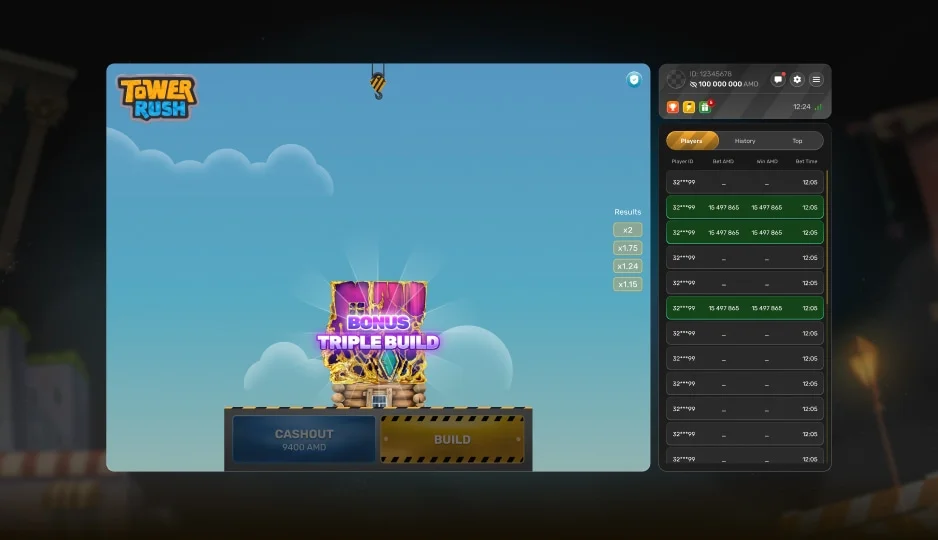
Something the interface does not spell out: the collapse point has already been determined before you ever press the button. The RNG has settled the outcome in advance -- your taps merely reveal it. There is no clever timing trick and no rhythm to exploit. Every round stands entirely on its own.
When to cash out
This is the pivotal choice in every round. You press the withdrawal button, your earnings are locked in, and the round concludes. The decision cannot be reversed.
The most common pitfall: you are sitting at 8x and convince yourself that one additional floor is harmless. At 9x, the same logic kicks in. At 10x, everything crumbles. Decide on a target multiplier BEFORE the round begins. Tell yourself "I am collecting at 5x this time" and follow through without deviation.
When the tower collapses
Your entire wager is gone. Full stop. There are no partial refunds or replays. The game returns you to the bet selection screen, ready for the next round.
The one impulse you absolutely must resist: inflating your bet on the following round to recover what was lost. That pattern is the fastest route to emptying your bankroll in crash games.
Tower Rush Is Provably Fair — Not a Skill Game
This is the most fundamental truth about Tower Rush: player skill does not influence outcomes. Regardless of how many hours you invest, how precisely you time each tap, or which strategy you employ, the result of every round is fixed in advance by a certified Random Number Generator (RNG) before your first block is placed.
Block placement doesn't matter
Each time you tap to add a floor, it can feel as though you are actively constructing something -- carefully selecting the right moment for each block. The reality is rather different: the timing, speed, and cadence of your taps have zero bearing on the outcome. The collapse threshold is locked in the instant the round starts. Whether you tap methodically or hammer the button as fast as you can, the tower will fall at the identical point.
The stacking animation is purely cosmetic. Rather than building a structure, you are gradually uncovering a result that was already written.
What "provably fair" actually means
Tower Rush employs a provably fair framework, meaning the outcome of every round is open to independent verification. Prior to each round, the server produces a cryptographic hash of the result. Once the round concludes, you can compare that hash against the actual outcome to confirm that nothing was altered mid-play. This is a mathematically verifiable safeguard, not a marketing slogan.
Galaxsys, the studio behind Tower Rush, holds gaming licences that mandate periodic third-party audits of their RNG systems. These checks verify that results are genuinely random and that no sequential dependency exists between rounds.
Why this matters for you
- No streaks to exploit: If the tower crumbled at 2x on five consecutive occasions, the sixth round carries exactly the same probability distribution. Historical results have absolutely no effect on what comes next.
- No click-timing advantage: Rapid tapping, deliberate pausing, or rhythmic clicking makes no difference whatsoever. The visual animation reacts to your input, but the underlying mathematics remain unchanged.
- No skill-based edge over other players: A veteran with thousands of rounds under their belt and a complete beginner share identical winning odds on any given round. Experience only helps with managing your money and choosing when to withdraw -- it cannot alter the game's probability model.
- The operator maintains a mathematical advantage: As with every casino game, Tower Rush has an inherent house edge (typically around 3-4%). Across a sufficiently large number of rounds, the operator will always come out ahead. Short-term gains are entirely possible, but no approach can negate this edge over the long haul.
None of this is intended to put you off. It is intended to keep you safe. Players who convince themselves they can "crack" crash games through ability tend to chase losses and overspend. Players who grasp how the RNG works play within sensible limits, appreciate the entertainment value, and know when to call it a day.
Tower Rush Bonuses: Reacting in the Middle of a Round
Three distinct bonuses can activate mid-round. Below is a practical breakdown of how to handle each one when it appears.
Frozen Floor - What to Do

When a freeze activates, everything halts for 3 to 5 seconds. The multiplier stands still and the tower cannot fall. It amounts to a compulsory breather in the middle of the action.
My own approach: whenever the Frozen Floor appears above 10x, I collect straight away. Those few pressure-free seconds are the ideal window to hit the withdrawal button without any rush. Below 10x, I use the pause to settle on a clear plan -- but the decision is made during the freeze, not once it expires.
A common error we see: allowing the freeze to elapse without reaching any conclusion, then continuing to build out of sheer inertia. The whole purpose of the freeze is to hand you thinking time. Take advantage of it.
Temple Floor - What to Do
The Temple Floor amplifies the value of each floor placed while it is active, multiplying the normal rate by a factor between 1.5x and 3x. This is the window where your earnings can spike dramatically -- but it is also the moment when overconfidence is most likely to cost you.
My personal rule: construct 3 to 4 floors during the Temple activation, then collect immediately. The urge to press on is powerful since every tap is delivering outsized returns, but the collapse probability does not decrease during a Temple. The bonus enhances your rewards -- it does nothing to shield the structure.
If the Temple triggers when you are already sitting above 15x, withdraw without a second thought. At those heights, the risk-reward balance tips sharply against continued building.
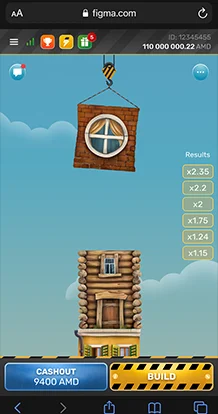
Triple Build - What to Do

A single tap places three consecutive floors. The multiplier vaults upward by +3 in one swift motion. It triggers more frequently than either of the other bonuses, and it carries the potential to wipe you out fastest when the tower is already tall.
In the early stages of a round (below 5x), Triple Build is genuinely helpful -- it fast-tracks your progress while the risk level is still manageable. Once you are above 12x to 15x, the picture changes sharply. Three floors landing at once on an already lofty tower can bring instant collapse. If you are already at a respectable multiplier, pocket the winnings and move on.
On the rare occasion that Triple Build and Temple Floor overlap, you gain roughly +6 to the multiplier from a single tap. When that happens, tap once and cash out immediately. Do not press your luck with a second click. For a thorough technical explanation of each bonus, visit our Tower Rush game features page.
Tower Rush Strategy: Which Style Fits You
The "small, steady wins" approach
Withdraw consistently at multipliers between 2x and 3x. Your individual gains will be modest, but they come frequently enough to keep your balance healthy over time.
To illustrate: stake £10, withdraw at 2.5x, and you pocket £15 in profit. Over the course of 10 rounds, you are likely to succeed on roughly 6 or 7 of them while losing 3 or 4. The overall margin is slim, but it accumulates steadily. This is the method we would recommend for anyone new to real-money play.
The "fixed target" approach
Select a specific multiplier before each round begins -- 7x, for instance -- and collect the instant you reach it. No wavering, no "perhaps one more floor."
The strength of this method lies in its discipline. Emotion is removed from the equation entirely. The trade-off is that the tower will occasionally collapse just short of your target -- hitting 6.8x when you needed 7x, for example. That stings in the moment, but over the long run a firm rule outperforms spur-of-the-moment improvisation every time.
The "adaptive" approach
You modify your withdrawal point on the fly depending on events within the round. If a bonus materialises early, you extend your climb slightly. If a dozen floors pass without incident, you collect.
This is the most mentally engaging way to play, though it also introduces the highest level of risk. Strict self-discipline is essential because "I am adapting to conditions" can easily morph into "I always convince myself to build one floor too many." If you opt for this style, impose an absolute hard ceiling (20x, for example) above which you always withdraw regardless of circumstances.
What doesn't work
Martingale-style systems -- where you double the stake after every loss -- have no mathematical advantage on Tower Rush. The house edge remains constant irrespective of your betting pattern. Escalating after a loss simply accelerates how quickly your funds deplete. Visit our responsible gaming guide for practical advice on protecting your bankroll.
The same applies to chasing perceived "patterns." If the tower fell at 2x on three successive rounds, the probability of it going higher on the fourth is no greater than it was before. Each round is a completely fresh event.
Mistakes to Avoid on Tower Rush
- Starting without a spending cap: Settle on a firm total before you open the game. Once that amount is exhausted, you are done for the day. No exceptions, no "just another £20."
- Bypassing the demo: There is absolutely nothing to lose by running 30 rounds in the free demo. It prevents you from spending real money to learn things you could have discovered for free.
- Chasing losses: After a string of collapses, the compulsion to raise your stake is intense. That is precisely the moment to step away from the screen. Our responsible gaming page provides practical mechanisms for staying in control.
- Passively waiting through bonuses: When a Frozen Floor activates, use those seconds purposefully. Make a conscious choice about whether to collect or continue.
- Playing when fatigued or irritated: Hasty decisions in crash games carry a steep cost. If your concentration is slipping or your mood has soured, shut the game down.
- Measuring yourself against other players: Every session is unique. The person who landed 50x yesterday almost certainly suffered a string of losses in the rounds leading up to it.
FAQ: Playing Tower Rush
Where do I start if I've never played Tower Rush before?
Head to any of our recommended casinos, create a free account, and look for the demo or practice mode toggle within the Tower Rush game screen. The demo lets you play unlimited rounds with virtual credits. Focus your first 20 to 30 rounds on understanding the tempo -- pay attention to when collapses tend to happen and experiment with cashing out at different multiplier levels to build your instincts.
How much should I budget for a gaming session?
A practical rule of thumb is to set aside between 20 and 50 times your intended bet size. If you plan to wager £5 per round, a session budget of £100 to £250 provides enough runway to absorb losing streaks without being forced to stop prematurely. Write the number down before you open the game and treat it as an absolute ceiling -- once it is spent, the session is over regardless of how the last few rounds went.
Can the tower collapse on the very first floor?
Yes, although it happens infrequently. The collapse threshold for every round is determined before you place your first block, so even floor one carries a small but real chance of failure. This is precisely why setting a bet size you are comfortable losing entirely on any single round is such an important part of the preparation process.
Should I change my bet between each round?
For most players, keeping a flat bet throughout the session produces the steadiest results. The only sensible reason to adjust mid-session is if your remaining balance has dropped significantly and the original stake now represents too large a proportion of what you have left. Avoid the temptation to double up after losses -- that pattern drains bankrolls far faster than flat betting does.
How can I tell if a bonus is about to appear?
You cannot. Bonus triggers are invisible until they activate, and there are no visual or audio cues beforehand. The practical takeaway for your gameplay is to never build your cash-out plan around a bonus appearing. Set your target multiplier as though no bonus will fire, and if one does materialise, treat it as an opportunity to reassess -- not as something you were counting on.